


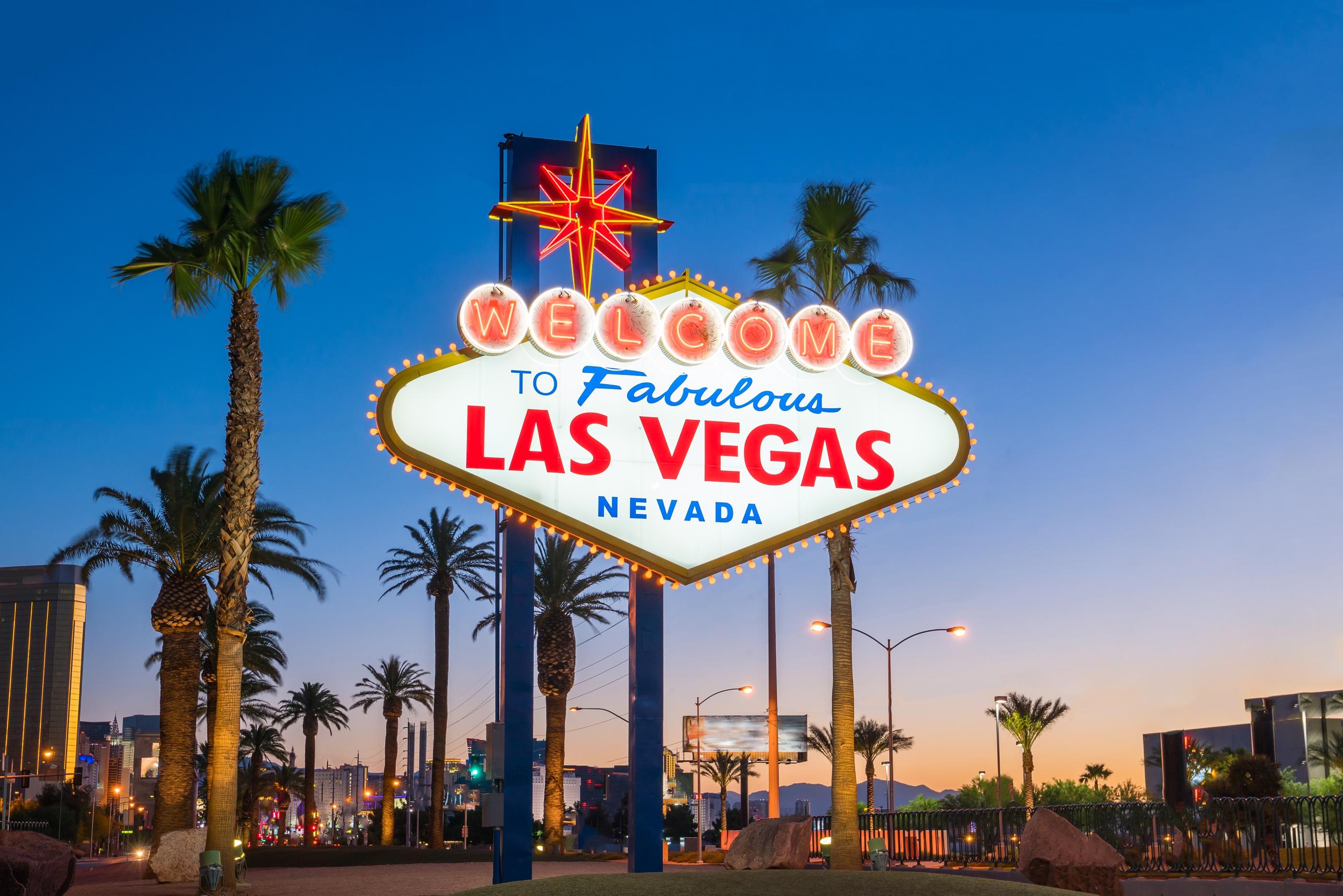
The Welcome to Fabulous Las Vegas sign is the “quintessential neon road sign and a staple of American culture,” according to the Neon Museum of Las Vegas.
Credit: f11photo/Shutterstock
After Scottish scientist Sir William Ramsay discovered neon and several other gases, he sent samples to NIST — then called the National Bureau of Standards — for further study.
Ramsay won the Nobel Prize in chemistry for this discovery in 1904. The gases Ramsay identified — neon, argon, helium, krypton and xenon — are known as noble gases because they’re a bit snobby and won’t readily combine with other gases.
NIST physicist Perley G. Nutting was charged with studying the absorption and emission of light and other radiation by matter, known as spectroscopy, with these noble gases. Nutting designed glass electric discharge tubes to hold the gases at a low pressure. When an electric charge was applied, they gave off a bright light.
During this time, NIST was also planning to show the public its research at the World’s Fair in St. Louis, which opened on April 30, 1904. NIST’s Edward O. Sperling blew the glass tubes into the names of the four gases that were in those tubes — argon, helium, hydrogen and neon. Fair attendees were fascinated by the glowing signs. These signs are still on display at NIST’s campus in Gaithersburg, Maryland.
The four gases featured in our signs all have Greek-derived names. With a pure electric charge, they each produce a distinct color, though the noble gases can be combined to create other colors.
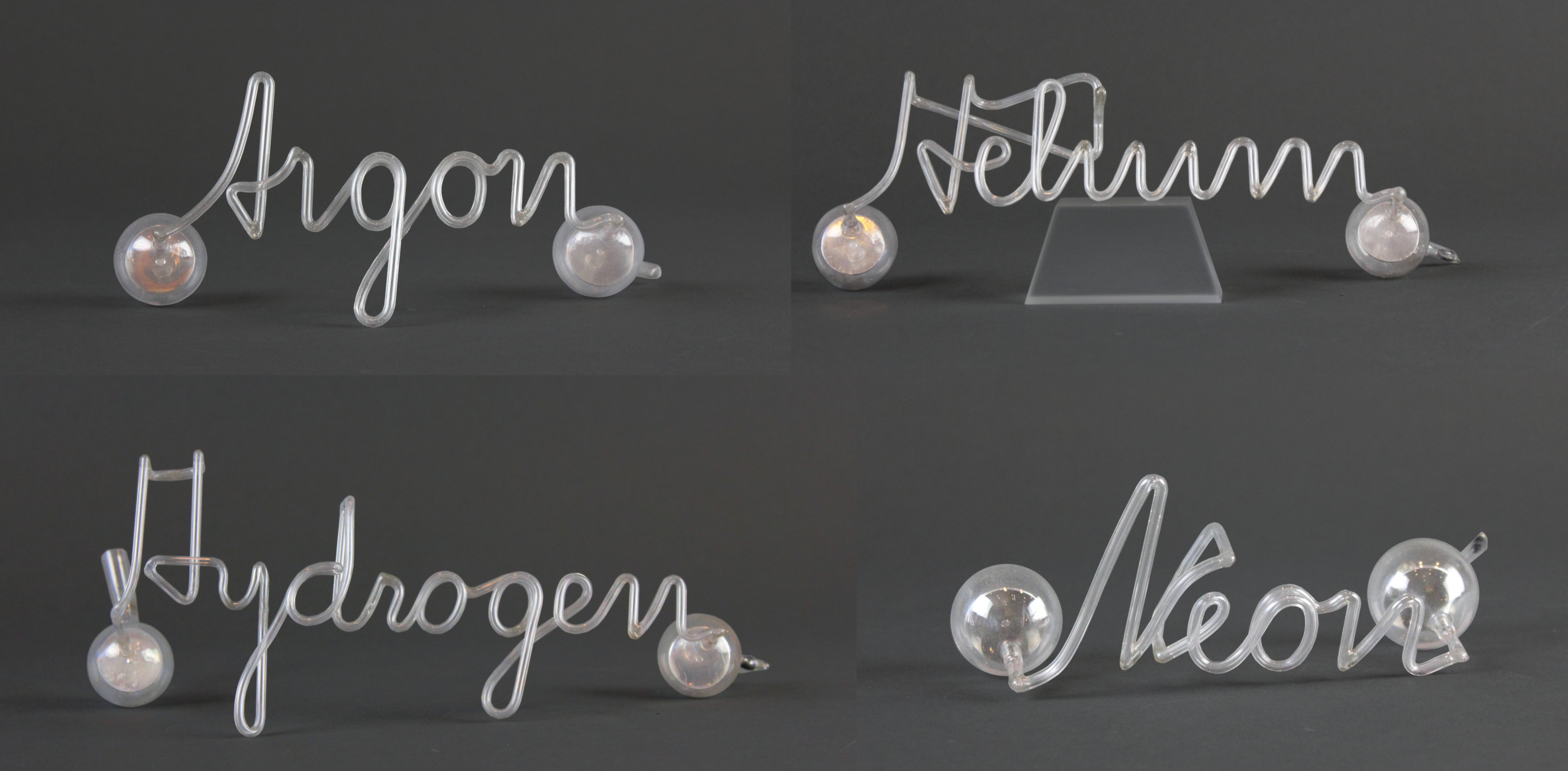
Argon, helium, hydrogen, and neon luminous script signs designed by Perley G. Nutting and fabricated by Edward O. Sperling of NBS in 1904. They are on display at NIST's campus in Gaithersburg, Maryland.
Credit: NIST Museum Collection
- Argon makes a blue color. Its name stems from the word for idle, lazy or inactive. Argon got this name because it’s inert to other substances(link is external).
- Helium makes a pale yellow color, and its name comes from the word for the Sun.
- Hydrogen is a pink-red in color. The name comes from a term for water forming.
- Neon makes an orange-red color. Its name means “new” in Greek.
Although our researchers enlightened the American public on these signs for the first time, what we now know as the neon sign was previously invented by a French engineer named Georges Claude(link is external) in 1902.
While NIST researcher Nutting was not the official inventor of the neon sign, his work was a predecessor of the neon signs(link is external) and florescent lamps that became available to the public beginning around 1930 and remained popular for a few decades. Additionally, the signs were one of NIST’s first notable lab accomplishments.

Perley G. Nutting (left) in 1917 and Edward O. Sperling (right) in 1918. Their collaboration at NBS produced a prototype for an entirely new industry.
Credit: NIST Archives
With their bright colors, noble gas-filled signs, commonly called neon signs, became iconic in the U.S. The first neon sign in the U.S. was built in 1923 in Los Angeles to advertise a car dealership(link is external).
Perhaps no place in America is more synonymous with neon signs than the Las Vegas Strip. (It even has a museum dedicated to them, as does St. Louis and a handful of other U.S. cities.) As the Strip was built up in the post-World War II boom, its massive neon signs(link is external) became famous.
Today, neon signs’ influence has mostly dimmed. LED is a less expensive and more energy efficient(link is external) alternative that is increasingly being used in signage. In Las Vegas, the famous “Welcome to Fabulous Las Vegas” sign is believed to be the only major neon sign(link is external) still in use.
While neon signs have mostly faded into history, one bright spot of this story is that NIST is still supporting innovations in lighting, including the standardization and calibration of modern lighting technologies.
原文源自美国国家标准与技术研究院(NIST)网站,版权归其所有。如有侵权,请联系,第一时间删除。