


KRISS establishes national resistance standard system with own technology
- Writerkrissadmin
- Date2020-04-08 00:00
- Hits138
KRISS establishes national resistance standard system with own technology
-Team successfully develops graphene-based quantum Hall standard resistance device-
The Korea Research Institute of Standards and Science (KRISS, President Hyun-Min Park) succeeded in developing a new standard resistance array to contribute to its next-generation quantum electronics standard system. As the national research institute dedicated to measurement standards, KRISS plans to supply the newly developed resistance array to overseas institutes of metrology.
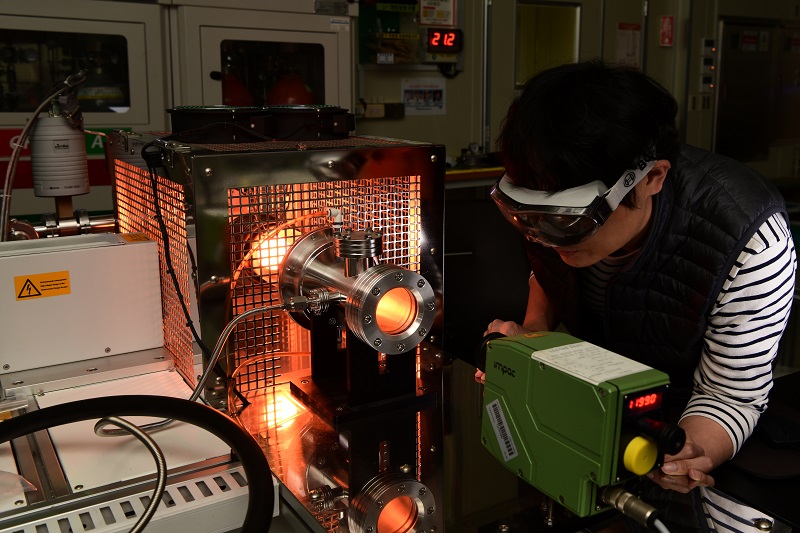
▲ Principal researcher Jaesung Park of KRISS Electricity and Magnetism Metrology Team is growing epitaxial graphene.
The current resistance standard system uses Quantum Hall devices based on GaAs semiconductors as a standard. However, they are difficult to operate as they require ultra-low temperatures (below 1.5 K*) and large magnetic fields (at least 10 T**).
* Kelvin (K): Base unit of thermodynamic or absolute temperature in the International System of Units. Represented by the symbol K.
** Tesla (T): Unit of magnetic flux density or magnetic field in the International System of Units. Represented by the symbol T.
Standard resistance devices made from graphene, known as the material of dreams, can be used under efficient experimental environments having relatively higher temperatures (above 4.2 K) and lower magnetic fields (below 5 T).
Graphene also supports AC quantum Hall standard resistance applications, and major metrological institutions such as PTB (Germany) and NIST (United States) are conducting research to use graphene in standard resistance devices.
? Next-generation quantum electricity standard systems implement AC quantum Hall standard resistance or AC quantum voltage to realize the impedance standard. They offer lower uncertainty than the DC type, showing great promise in precision measurements.
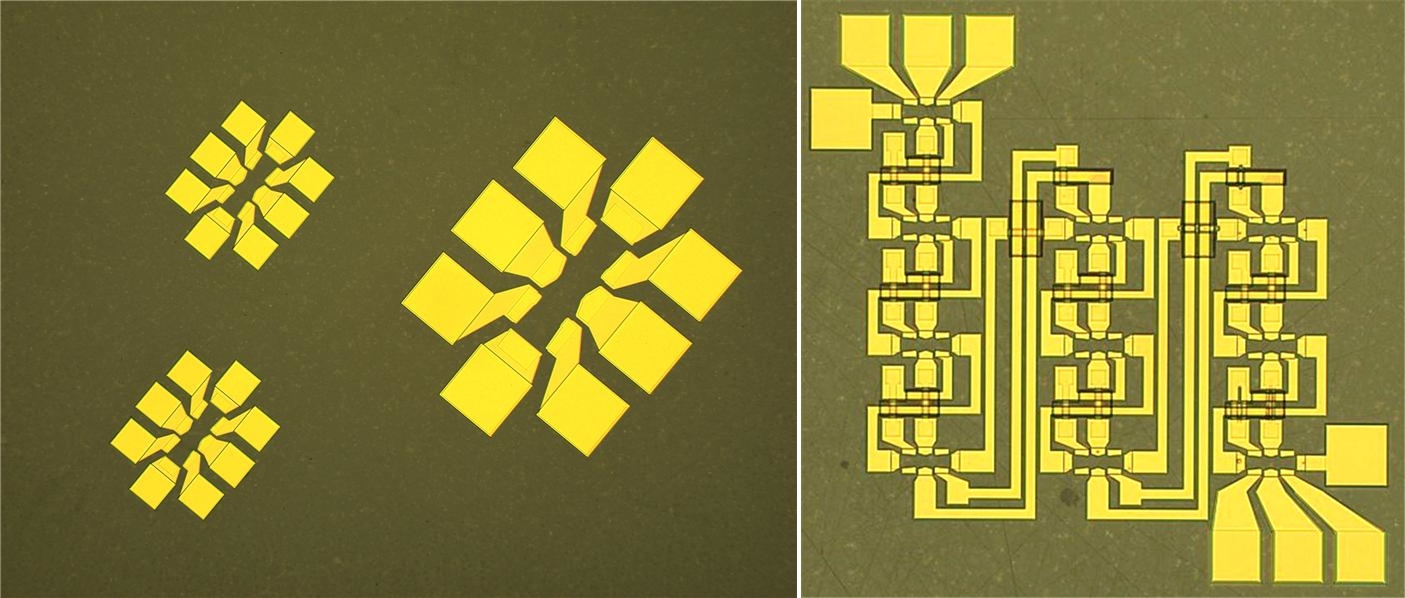
▲ Graphene-based single standard resistance device(left), high-resistance array device(right)
The Electricity and Magnetism Metrology Team* grew epitaxial graphene at high temperatures above 1600 ℃, and developed an appropriate device process technique. This was then used to develop a single graphene quantum Hall device (12.9 kΩ) and a 129 kΩ graphene-based quantum Hall high-resistance array comprised of 10 devices connected in series.
* KRISS Electricity and Magnetism Metrology Team: principal researchers Jaesung Park, Dong-Hun Chae, and Wan-Seop Kim
KRISS is the third in the world, after PTB (Germany) and NIST (United States), to fabricate quantum Hall devices by growing epitaxial graphene. It is also the world’s first to fabricate a quantum Hall high-resistance array comprised of 10 quantum Hall devices connected in series.
KRISS developed a quantum Hall resistance measurement system in 2008 to establish a national resistance standard system. With the new resistance array, the national resistance standard system* can now rely on domestic technology without using standard resistance devices provided by overseas metrology institutes.
* National resistance standard system: Establishment of the national resistance standard system (precision measurement) and standard resistance device
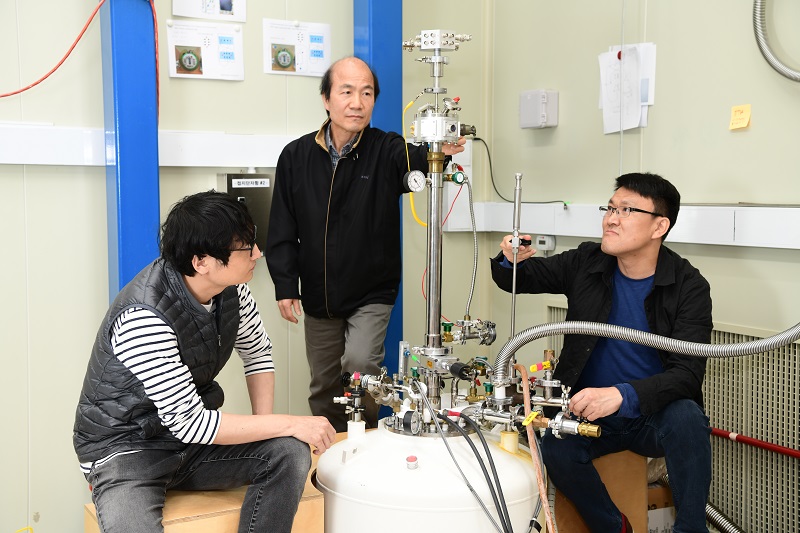
▲ The research team of KRISS Electricity and Magnetism Metrology Team is operating a precise measurement system.
Principal researcher Jaesung Park said, “KRISS will supply its standard resistance array to overseas metrology institutes for international comparisons. The array is expected to have various applications in quantum current standards, and will significantly enhance the reliability of devices used in the measurement and production of microcurrents.”
Supported by KRISS and the National Research Foundation of Korea, the study was published in the March issue of Applied Physics Letters (IF: 3.521), an international journal in applied physics.
原文源自KRISS网站,版权归其所有。如有侵权,请联系,第一时间删除。